
An Inventory Planner alternative that plans inside Odoo
If you plan in Inventory Planner and buy in Odoo, you keep two systems in step by hand. The forecast sits in one app, the purchase order in another, and someone re-keys the number between them.
Niyu Smart Stock is an Odoo demand forecasting app that plans the same products inside Odoo, so the planning decision and the Odoo document are one workflow. Below is a straight, sourced comparison, including where Inventory Planner is the stronger choice.
 native moduleno card to startOdoo 16 to 19
 Inside Odoo
The parallel run
Keep Inventory Planner running. We plan the same products inside Odoo for four weeks, scoped to one warehouse and your top 500 SKUs. At the end you have two recommendation sets for the same period on the same data, and you can see which one you would have acted on. Setup is on a call with us, at no cost, and there is no card involved.
One system behind, all the time
When the planner lives outside your ERP, its picture of stock is only as fresh as the last sync. Teams describe the gap plainly on review sites.
“Being 1 day behind our ERP.”
“The lack of live data, we often still need to be looking in our ERP system while ordering.”
Buyer language from public Capterra reviews of inventory planning software, retrieved 2026. Quoted to show the category pain of running a planner outside the ERP, not to put any one product down.
The difference in one paragraph
If you want the answer before the detail, here it is.
Inventory Planner by Sage is a mature, ecommerce-first forecasting and open-to-buy tool, built first for storefronts like Shopify. If you run on Odoo, it reaches your data through third-party middleware rather than a native connector, forecasts with one general approach, and handles stock transfers through the platform it is synced with. Niyu Smart Stock takes the opposite path. It is a module inside Odoo, so there is nothing to bridge. It picks a forecast model per product with guardrails and a confidence score, recommends a transfer across your warehouses before it buys, splits one need into a move and a smaller purchase, and drafts the real Odoo orders for your team to approve. Its pricing is flat and published, from a permanent free tier upward, rather than quoted against your revenue.
Forecasting that adapts per product
A model chosen for each product, with guardrails and a confidence score, instead of one general method.
Every warehouse, transfer before buy
Plans inter-warehouse transfers with multi-donor allocation, then buys only the gap that is left.
Flat pricing, more value
Published $0, $79, and $249 per month, by catalog and warehouses, not a quote that climbs with revenue.
The same job, from two very different places
The clearest difference is not on a feature list, it is where the planning happens and how your data gets there.
Your planning data leaves Odoo, runs in a separate app, and is synced back through a connector you set up and maintain.
 Smart StockNative Your Odoo
Planning happens where your stock, purchase orders, and transfers already live. There is no middleware to buy, and no inbound access to your database.
Side by side, on the points that decide it
Where Inventory Planner is genuinely strong, we say so. These rows are about fit for an Odoo operation, not a scorecard.
1 Inventory Planner pricing is quote-based and tied to revenue. The figures above are publicly reported, not official list prices, and were correct at the time of writing. Confirm current pricing with the vendor. Sources: Inventory Planner Odoo integration, APIWorx Odoo middleware, RevenueGeeks pricing report, TrustRadius pricing.
What changes when the planner lives inside Odoo
The differences that matter most to teams moving from an ecommerce-first tool to an Odoo-native one.
A model chosen for each product, not one method for all
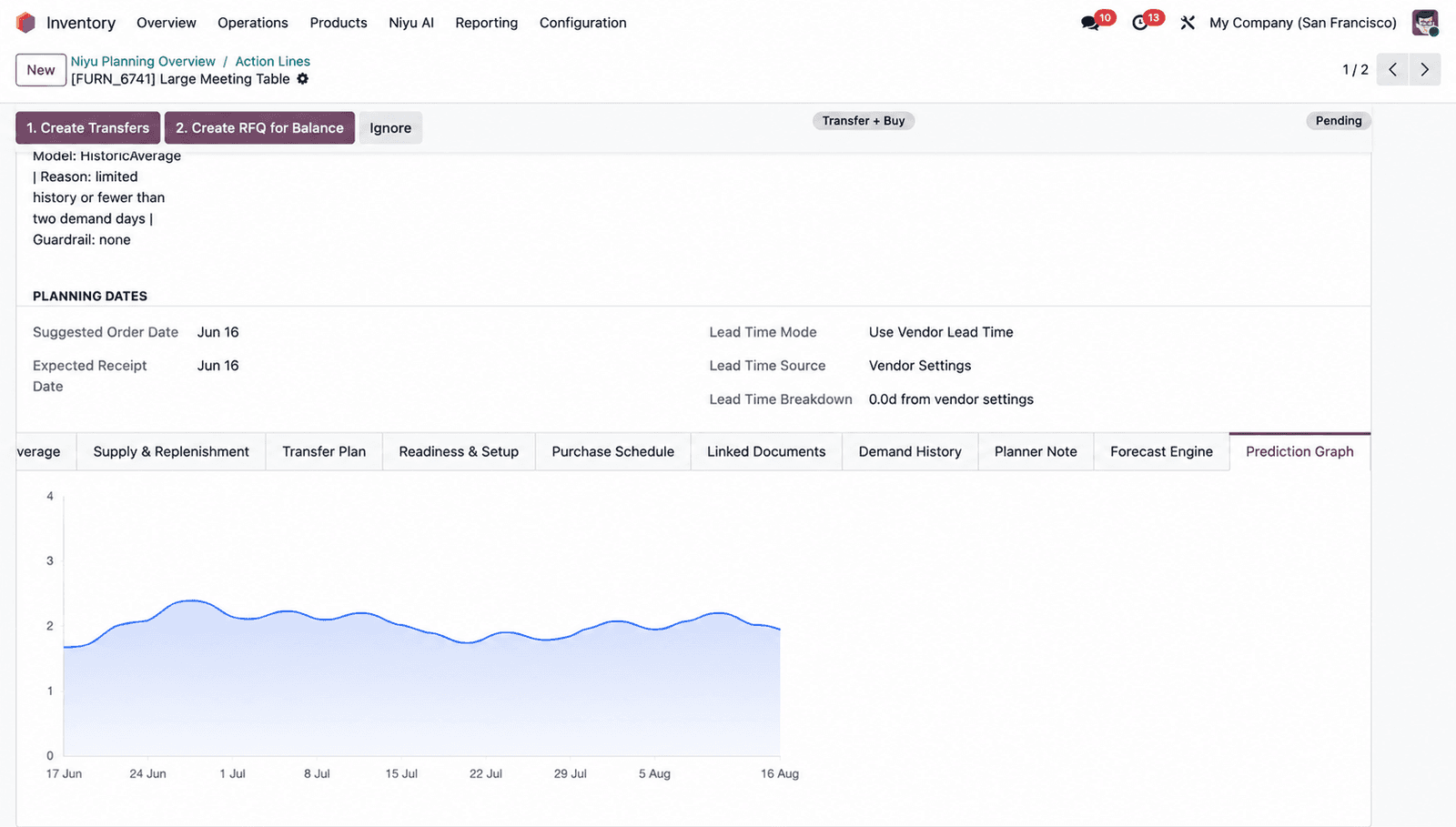
Inventory Planner forecasts well for the steady, high-volume sellers an ecommerce catalog is full of. Real Odoo catalogs are messier: slow movers, spare parts, seasonal lines, and brand new products with almost no history. Smart Stock routes a model per product. It uses Croston-style methods for intermittent demand, historical-average methods where history is thin, and a zero model where there is no demand yet, each with guardrails and a confidence score on every line. You see which model was used and why, so a few large orders never inflate a forecast and a quiet new product is not handed a made-up number.
Intermittent
Croston-style for spiky, irregular movers
Limited history
Historical-average when data is thin
No history
A zero model instead of inventing a number
 Inside Odoo
Transfer across every warehouse, then buy only the gap
When one warehouse is short and another holds spare units, the cheapest fix is a transfer, not a purchase order. Inventory Planner is built around buying, and cross-warehouse handling leans on the platform it is synced with, which fits a couple of locations more than a network of them. Smart Stock plans the move first. It looks across every warehouse, suggests an internal transfer for stock you already own, and buys only the remaining gap. When several warehouses can donate, the Transfer Plan shows where each unit comes from and keeps every donor's own safety buffer intact.
 Inside Odoo
It drafts the Odoo documents you approve
A recommendation is only useful if it turns into work. Because Inventory Planner lives outside your ERP, its output is forecasts and suggested orders that sync back through the connector. From a Smart Stock action line you create a real Odoo RFQ or internal transfer directly, tagged with its source and linked back to the line. It stays a draft until your team confirms it through your normal approval flow. Nothing is sent to a vendor automatically, and nothing leaves Odoo to be reconciled later.
 Inside Odoo
The planner's number drives the Odoo document, and survives the next run
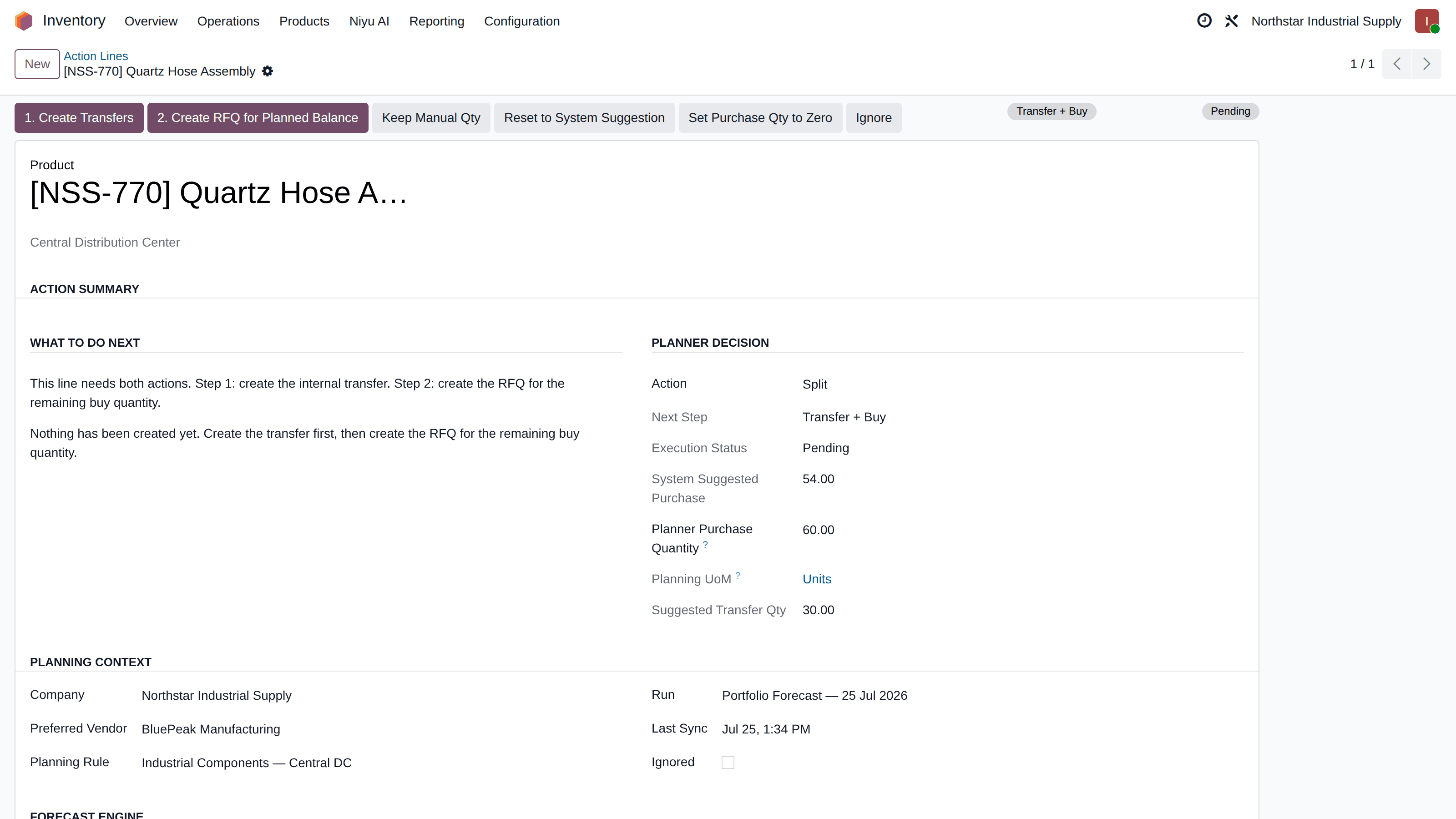
Because the plan lives in a separate app, a number you agree on has to be re-keyed into an Odoo purchase order, and a later sync can quietly move it. Smart Stock keeps two values on every line: a read-only system suggestion and the Planner Purchase Quantity you set. Your number, including an explicit zero, is what drafts the RFQ. If a newer forecast changes the suggestion after you decide, the line is flagged for review instead of being overwritten, and once the purchase order is confirmed it is not changed behind you. Policy, review, the draft RFQ and internal transfer, and the audit links all stay in Odoo.
 Inside Odoo
See the demand behind every number
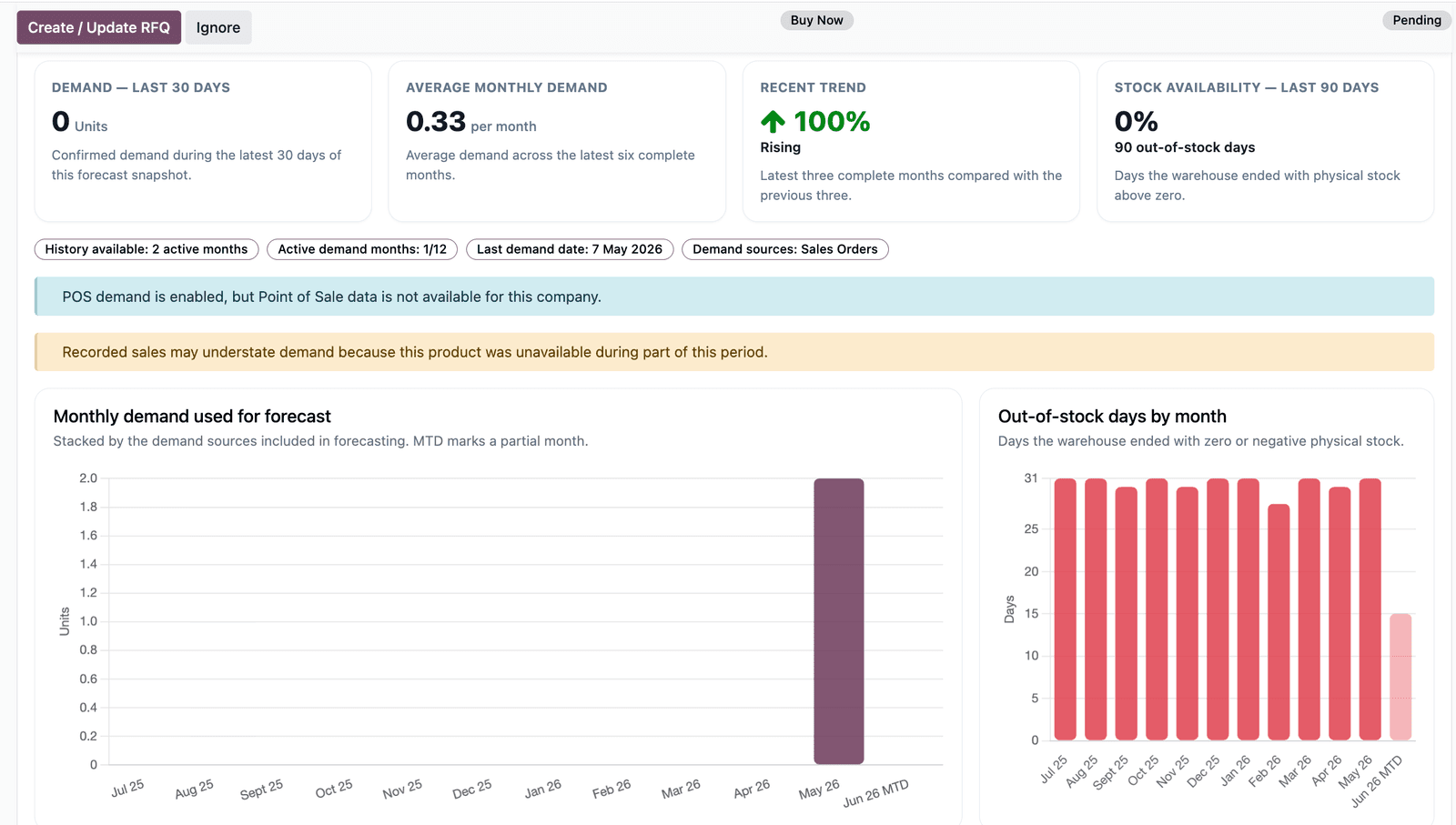
Forecasts earn trust when you can check them. Open any product and Smart Stock shows the demand history it learned from: monthly demand by source, the days the product was actually out of stock, the in-stock rate, the model it chose, the reason, and a confidence score. When a quiet month was really a hidden stockout, it flags that, so you do not cut a reorder for the wrong reason. Every figure can be reconciled against the same Odoo records your team already trusts.
 Inside Odoo
The same scope, for much less, with no quote
Inventory Planner's entry pricing covers roughly a thousand orders and SKUs and a couple of warehouses, and climbs with your annual revenue. Niyu Smart Stock covers more, at a flat price you can read before you talk to anyone.
~$245 to $299/mo1
Publicly reported entry pricing for roughly 1,000 orders and SKUs. Revenue-based and quote-gated, so the figure rises as you sell more, and you request a quote to learn your number.
- Price grows with your revenue
- Built around a small number of warehouses
- No permanent free tier
Smart StockFree
Up to 50 products, 2 warehouses
$0/mo
Pro
Up to 2,000 products, 3 warehouses
$79/mo
Business
Up to 5,000 products, 4 warehouses
$249/mo
Flat and published. You pay for catalog size, warehouses, and forecast horizon, never for selling more. The free tier never expires.
See plans and start freeWhich one is the right fit for you
No tool is best for everyone. The right choice comes down to where your data lives and how many warehouses you run.
Inventory Planner is the better fit
- Your catalog lives in Shopify or another storefront, not Odoo
- You run one or a couple of warehouses
- You want open-to-buy and merchandising reports for an ecommerce brand
Strong when your data sits outside Odoo and your network is small.
Smart StockNiyu Smart Stock is the better fit
- Odoo is your source of truth for stock, purchases, and transfers
- You run several warehouses and move stock between them
- You want a model per product, transfer-before-buy control, and flat pricing
Built for Odoo operations that span warehouses and want more control for less.
Built with people who have used the others
Niyu Smart Stock was shaped with inventory teams and planners who had run other tools, Inventory Planner among them, and knew exactly which parts they relied on and which parts fought their Odoo workflow. We kept what worked, the forecasting discipline and the open-to-buy thinking, and built it where their stock already lived. That is why the model-per-product forecasting, the transfer-before-buy logic, and the per-line evidence are front and centre. They were asked for.
Switching from Inventory Planner is low risk
You do not have to take it on faith. Prove Smart Stock on your own Odoo data, next to your current tool, before you move a thing.
Prove it on your own data
Install the module and run Smart Stock next to your current tool on the permanent free tier. Compare the recommendations on products you already know well.
Nothing to migrate or rebuild
Smart Stock reads sales history, stock, and incoming supply straight from Odoo. There is no data export, no rebuild, and no middleware to stand up first.
Keep full control
Set service levels, safety stock, lead-time mode, MOQ, and order multiples per product or across the catalog. Every buy and transfer stays a draft until you approve it.
Switch when it is clearly better
Move over only when the plan beats what you have. The parallel run and paid on-call setup mean you see the recommendations on your own data before you commit.
Paid clients get on-call setup. We connect on a call to install the module, paste your API key, run the first sync, and set your planning rules so the first recommendations are useful from day one.
What Smart Stock is, and is not
So the parallel run tells you something real, here is where it fits and where it does not.
Decision support, not automated purchasing
Smart Stock drafts RFQs and internal transfers for your team to approve. Nothing is sent to a vendor automatically. Buyers keep the final call on what to order, from whom, and when.
Not for Odoo Online (SaaS)
It installs on Odoo.sh, self-hosted, and on-premise Odoo, including Docker, on Odoo 16 to 19, Community and Enterprise. It cannot install on Odoo Online, which does not allow custom modules.
Output depends on your Odoo data
The recommendations are only as good as the sales history, lead times, vendors, and warehouse mapping in Odoo. Cleaner master data means better plans, which is part of what the parallel run checks.
Questions teams ask before switching
Is there an Inventory Planner alternative for Odoo?+
Yes. Niyu Smart Stock is an Odoo-native alternative to Inventory Planner by Sage. It forecasts demand per product per warehouse with a model chosen per product, recommends what to buy and what to transfer, and drafts the matching Odoo purchase orders and internal transfers, all inside Odoo rather than in a separate app.
How is the forecasting different?+
Inventory Planner uses one general forecasting approach across products. Smart Stock routes a model per product: Croston-style methods for intermittent demand, historical-average methods where history is thin, and a zero model where there is no demand yet. Each line carries guardrails and a confidence score, and shows the model and the reason, so you can see why a number is what it is.
Does Inventory Planner integrate with Odoo?+
Inventory Planner is an ecommerce-first product, built first for platforms like Shopify. It can reach Odoo, but publicly its Odoo connection runs through third-party middleware such as Cogent2 or APIWorx rather than a native connector. That means your planning data leaves Odoo and syncs back, so the plan and the purchase order live in two systems you reconcile. Niyu Smart Stock is a module that runs inside Odoo, so the planning decision and the Odoo document are one workflow with no middleware in between.
What is the four-week parallel run?+
Keep Inventory Planner running. We plan the same products inside Odoo for four weeks, scoped to one warehouse and your top 500 SKUs. At the end you have two recommendation sets for the same period on the same data, and you can see which one you would have acted on. Setup is on a call with us, at no cost, and there is no card involved. It suits teams whose catalog is larger than a self-serve free tier would hold.
How many warehouses can it handle, and can it transfer between them?+
Smart Stock plans across every warehouse in your Odoo database. When one is short and others have spare stock, it suggests an internal transfer first, then buys only the remaining gap. When several warehouses can donate, the Transfer Plan shows where each unit comes from and keeps every donor's safety buffer protected.
Can it split one need into a transfer and a purchase?+
Yes. A short of 80 units with 30 spare in another warehouse becomes transfer 30 and buy 50, in one recommendation. You can also split a large buy into planned batches with their own receipt dates.
How does the pricing compare?+
Niyu Smart Stock has flat, published pricing: Free at $0, Pro at $79 per month, and Business at $249 per month, with a permanent free tier. Inventory Planner uses revenue-based, quote-gated pricing that is publicly reported to start around $245 to $299 per month for roughly a thousand orders and SKUs and a couple of warehouses, and to rise with annual revenue. The same scope costs much less on a flat Niyu tier. Always confirm current pricing with each vendor.
Do I have to leave Odoo to use it?+
No. Smart Stock is a module under the Odoo Inventory app. You plan, review the evidence, and create the purchase orders and transfers without leaving Odoo. Your Odoo instance only needs to make outbound HTTPS requests to the forecasting service. No inbound access to your database is required.
Can I try it before switching?+
Yes. You can run a four-week parallel run on your own data next to Inventory Planner, or start on the permanent free tier, which includes every feature for up to 50 products and 2 warehouses with no card required. Either way you compare the recommendations before you move anything.
Which Odoo versions are supported, and does it work on Odoo Online?+
Niyu Smart Stock supports Odoo 16 to 19, on both Community and Enterprise. It installs on Odoo.sh, self-hosted, and on-premise Odoo, including Docker. It cannot install on Odoo Online (SaaS), because that hosting does not allow custom modules.
Run both for four weeks, then decide
See two recommendation sets on the same data, on your own Odoo, before you move anything.
The parallel run
Keep Inventory Planner running. We plan the same products inside Odoo for four weeks, scoped to one warehouse and your top 500 SKUs. At the end you have two recommendation sets for the same period on the same data, and you can see which one you would have acted on. Setup is on a call with us, at no cost, and there is no card involved.
Prefer the full product tour? See everything Niyu Smart Stock does.
Inventory Planner and Sage are trademarks of The Sage Group plc and its licensors. Odoo is a trademark of Odoo S.A. Niyu Labs is an independent software company and is not affiliated with, endorsed by, or sponsored by Sage or Odoo. Brand names and logos are used only to identify the products being compared. This comparison reflects publicly available information as of June 2026 and our own product, and is provided for evaluation. Confirm current features and pricing with each vendor before deciding.